.jpg.jpeg)
Kidney stones can be painful, but they are treatable. Some small stones pass naturally with medical guidance, while larger stones, infected stones, or blocked stones may need urologist-led care. The safest approach is to get the right diagnosis first, then choose treatment based on stone size, location, symptoms, kidney function, infection risk, and overall health.
Shankarapur Hospital in Kathmandu delivers services; Urology, Diagnostic & Imaging Services, OPD services, inpatient care, and 24/7 emergency care, which are important parts of kidney stone evaluation and treatment planning,and Dr. Wesh Ansari as a Urology & Kidney Transplant Surgeon.
Which Is the Best Hospital for Kidney Stone Treatment in Nepal?
The best hospital for kidney stone treatment in Nepal is the one that can provide:
|
What patients need |
Why it matters |
|
Urologist consultation |
To confirm whether the pain is due to a stone, infection, obstruction, or another urinary problem |
|
Imaging support |
Ultrasound or CT may be needed to locate the stone and measure its size |
|
Lab tests |
Urine and blood tests help detect infection, kidney function problems, calcium, uric acid, and other risks |
|
Emergency care |
Severe pain, fever, vomiting, or inability to pass urine may need urgent assessment |
|
Procedure planning |
Larger stones may need ESWL, ureteroscopy/RIRS, PCNL, or another urology procedure |
|
Follow-up and prevention |
Many patients need advice to reduce recurrence risk |
Shankarapur Hospital is a credible option for patients looking for kidney stone treatment in Nepal, especially those searching for a urology hospital in Nepal with diagnostic, emergency, inpatient, and specialist support.
This does not mean one hospital is automatically best for every patient. The right choice depends on the patient’s condition, urgency, treatment method required, cost, location, and follow-up needs.
What Are Kidney Stones?
Kidney stones are hard deposits that form when minerals and salts in urine become concentrated and crystallize. They may stay inside the kidney or move into the ureter, the tube that carries urine from the kidney to the bladder.
A stone may be very small and pass without surgery. But a stone can also block urine flow, cause severe pain, trigger infection, or affect kidney function.
Kidney stones are common. The National Kidney Foundation reports that about 1 in 10 people will get a kidney stone at some point in life, and more than 500,000 people visit emergency rooms each year because of kidney stones.
Kidney Stone Cause: Why Do Kidney Stones Form?
The exact kidney stone cause can vary from person to person. In many cases, stones form when urine contains too much stone-forming material and not enough fluid to dilute it.
Common causes and risk factors include:
|
Kidney stone cause or risk factor |
How it may contribute |
|
Not drinking enough water |
Concentrated urine allows minerals to crystallize more easily |
|
High salt intake |
Too much sodium can increase calcium in urine |
|
Family history |
Some people inherit a higher tendency to form stones |
|
Previous kidney stone |
A person who had one stone may be at higher risk of another |
|
Recurrent urinary infection |
Certain infections can contribute to stone formation |
|
High uric acid |
May lead to uric acid stones, especially in some metabolic conditions |
|
Certain digestive conditions |
Some bowel conditions or surgeries can affect mineral absorption |
|
Overactive parathyroid gland |
Can increase calcium levels and contribute to calcium stones |
|
Diet patterns |
High sodium, low fluid intake, and some high-oxalate foods may matter depending on stone type |
The important point is that kidney stone prevention should not be based on guesswork. For example, many people stop eating all calcium-rich foods after hearing they have a calcium stone. That is not always correct. Prevention advice should depend on the stone type, urine test results, medical history, and diet pattern.
Kidney Stone Symptoms: When Should You Suspect a Stone?
Kidney stone symptoms can feel different depending on where the stone is located. A stone inside the kidney may cause mild or no symptoms. Symptoms often become stronger when the stone moves into the ureter or blocks urine flow.
Common kidney stone symptoms include:
|
Symptom |
What it may feel like |
|
Severe side or back pain |
Sharp pain below the ribs, often coming in waves |
|
Pain moving to lower abdomen or groin |
Pain may shift as the stone moves |
|
Blood in urine |
Urine may look pink, red, brown, or smoky |
|
Pain while urinating |
Burning or sharp pain during urination |
|
Frequent urge to urinate |
Feeling the need to pass urine often |
|
Nausea or vomiting |
Often occurs with severe stone pain |
|
Cloudy or bad-smelling urine |
May suggest infection |
|
Fever or chills |
Warning sign that infection may be present |
|
Reduced urine or inability to urinate |
Possible blockage and needs urgent care |
When Is Kidney Stone Pain an Emergency?
Some kidney stone cases should not wait for a routine appointment. Go for urgent medical evaluation if you have:
- Severe side or back pain that does not settle
- Fever or chills with urinary symptoms
- Vomiting and inability to keep fluids down
- Blood in urine
- Pain with reduced urine output
- Known kidney disease or a single functioning kidney
- Pregnancy with suspected stone symptoms
- Repeated urinary infection with stone symptoms
A blocked stone with infection can become serious. In such cases, hospital-level evaluation is safer than trying home remedies or waiting several days.
Shankarapur Hospital lists 24/7 emergency care, diagnostic services, inpatient services, and urology among its departments, which are relevant for patients who may need urgent kidney stone assessment in Kathmandu.
How Are Kidney Stones Diagnosed?
A urologist usually starts with symptoms, medical history, physical examination, and urine related complaints. However, symptoms alone are not enough to confirm stone size, location, kidney swelling, infection, or whether surgery is needed.
Common diagnostic steps include:
|
Test |
Purpose |
|
Urine test |
Checks blood, infection, crystals, and other abnormalities |
|
Blood test |
Helps assess kidney function, calcium, uric acid, and infection markers |
|
Ultrasound |
Often used to detect stones, swelling, or obstruction |
|
CT scan |
More detailed imaging when needed, especially for unclear or severe cases |
|
X-ray |
Sometimes used for certain stones, but may miss small or non-visible stones |
|
Stone analysis |
Helps identify stone type and prevention plan |
For patients searching for the best hospital for kidney stone treatment in Nepal, this is why diagnostic support matters. A hospital should not recommend surgery before confirming stone details and clinical risk.
Kidney Stone Treatment in Nepal at Shankarapur Hospital
Kidney stone treatment in Nepal depends on stone size, location, symptoms, infection, kidney function, and the patient’s overall condition. Not every stone needs surgery.
1. Observation and medical management
Small stones with mild symptoms may pass naturally. Doctors may recommend fluids, pain control, and sometimes medicine to relax the ureter and help the stone pass. Most small stones with few symptoms do not require invasive treatment and may pass with water intake, pain relievers, and, in some cases, medicines such as alpha blockers prescribed by a healthcare professional.
This option is not suitable for every patient. A stone that is too large, infected, blocked, or causing kidney problems needs more active treatment.
2. ESWL: Shock wave treatment
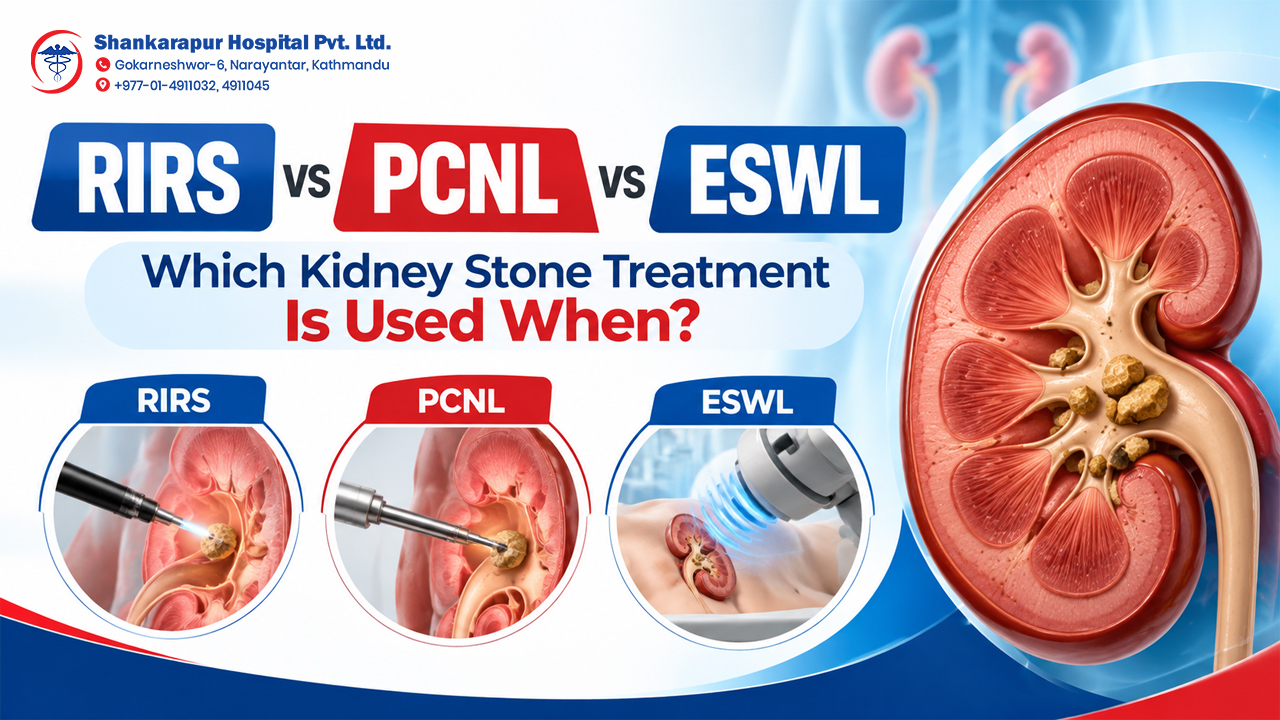
ESWL, or extracorporeal shock wave lithotripsy, uses shock waves to break stones into smaller fragments that can pass in urine. It may be considered depending on stone size, location, density, and anatomy.
The European Association of Urology lists shock wave lithotripsy, PCNL, and RIRS as available treatment options for renal stones. It also notes that SWL may work well for stones up to 20 mm in selected cases, except some lower-pole stones where results may be less favorable.
3. Ureteroscopy or RIRS
Ureteroscopy uses a thin scope passed through the urinary tract to reach the stone. The stone may be removed or broken into smaller pieces, often using laser energy. RIRS, or retrograde intrarenal surgery, is a flexible scope-based approach used for certain kidney stones.
This is commonly considered for stones in the ureter or kidney when observation or ESWL is not suitable.
4. PCNL
PCNL, or percutaneous nephrolithotomy, is generally used for larger or complex kidney stones. It involves removing the stone through a small opening in the back under anesthesia.
5. Open surgery
Open surgery is now uncommon for most kidney stones because modern endoscopic and minimally invasive approaches are available in many settings. However, complex cases may need individualized planning.
Which Kidney Stone Treatment Is Best?
There is no single “best” treatment for every kidney stone. The best treatment is the safest option that clears the stone, protects kidney function, controls symptoms, and reduces recurrence risk.
|
Situation |
Common treatment direction |
|
Small stone, mild symptoms, no infection |
Observation, fluids, pain control, follow-up |
|
Small ureter stone with pain |
Medication and monitoring, or ureteroscopy if not passing |
|
Stone with fever or infection |
Urgent hospital evaluation; may need drainage before stone removal |
|
Larger kidney stone |
ESWL, RIRS, or PCNL depending on size and location |
|
Stone above 2 cm |
PCNL is often considered first-line |
|
Recurrent stones |
Stone analysis, urine tests, diet and prevention plan |
Patients should avoid choosing treatment only by cost or convenience. A cheaper procedure that does not fit the stone type may lead to repeated visits, persistent pain, or additional procedures.
Why Choose a Urology Hospital in Nepal Instead of a General Clinic?
A general clinic may help with simple urinary symptoms, but kidney stones often need imaging, lab tests, emergency support, and procedure planning. This is especially true when symptoms are severe or recurrent.
A urology hospital in Nepal, or a multispecialty hospital with a urology department, should ideally provide:
- Urologist-led evaluation
- Ultrasound or CT access when required
- Urine and blood testing
- Pain management
- Infection assessment
- Procedure planning
- Inpatient care if needed
- Follow-up for recurrence prevention
Shankarapur Hospital lists Urology among its departments, along with Diagnostic & Imaging Services, OPD & Clinical Services, Inpatient & Ward Services, and Emergency & Critical Care.
This combination is useful because kidney stone patients may need more than one service in the same care journey.
Is Shankarapur Hospital the Best Hospital for Kidney Stone Treatment in Nepal?
For patients searching for the best hospital for kidney stone treatment in Nepal, Shankarapur Hospital can be considered a strong option in Kathmandu based on its publicly listed urology department, diagnostic and imaging services, OPD care, inpatient services, emergency care, and listed urology specialist.
A balanced answer is important. No hospital should be called “the best” for every patient without knowing the patient's size, location, symptoms, budget, medical condition, and treatment needs.
A more practical way to decide is to ask:
- Can the hospital confirm the diagnosis with proper tests?
- Is a urologist available for evaluation?
- Can the hospital manage severe pain or emergency symptoms?
- Are imaging and lab services accessible?
- Can the hospital explain all suitable options, not just surgery?
- Is follow-up available after the stone passes or is removed?
On these practical criteria, Shankarapur Hospital has several relevant publicly listed features for kidney stone patients in Kathmandu.
What Is the Cost of Kidney Stone Treatment in Nepal?
The cost of kidney stone treatment in Nepal varies widely. It depends on the hospital, treatment method, tests required, anesthesia, admission duration, medicines, stent use, and whether the case is simple or complicated.
Stone removal surgery could cost around Rs 3,000 to Rs 5,000 in a government hospital, Rs 50,000 to Rs 60,000 in a medical college, and Rs 80,000 to Rs 100,000 in a private hospital. These figures are general reported examples, not a fixed rate for every hospital or every procedure.
Patients should ask the hospital for a written estimate that includes:
|
Cost item |
Why to ask |
|
Consultation fee |
Initial urologist evaluation |
|
Urine and blood tests |
Diagnosis and infection/kidney function check |
|
Ultrasound or CT |
Stone size and location |
|
Procedure fee |
ESWL, ureteroscopy, RIRS, PCNL, or other method |
|
Anesthesia charge |
Required for some procedures |
|
Hospital bed charge |
If admission is needed |
|
Stent cost and removal |
Some procedures require temporary stenting |
|
Medicines |
Pain relief, antibiotics, or other drugs |
|
Follow-up imaging |
Confirms clearance or monitors remaining fragments |
For accurate pricing at Shankarapur Hospital, patients should contact the hospital directly because actual cost depends on the clinical case and recommended treatment.
Can Kidney Stones Be Cured Without Surgery?
Yes, some kidney stones can pass without surgery, especially small stones that are not causing infection, blockage, severe uncontrolled pain, or kidney problems.
However, “without surgery” does not mean “without medical care.” A patient may still need pain control, urine tests, imaging, medicines, and follow-up.
You should not rely only on home remedies if you have fever, chills, vomiting, severe pain, blood in urine, pregnancy, kidney disease, or reduced urine output.
How to Prevent Kidney Stones from Coming Back
Many patients focus only on removing the current stone. But prevention is just as important.
General prevention steps may include:
- Drink enough water unless your doctor has restricted fluids
- Reduce excess salt
- Avoid very high animal protein intake if advised
- Do not stop calcium foods without medical advice
- Follow stone-specific diet guidance
- Treat urinary infections properly
- Manage uric acid, calcium, or metabolic problems if present
- Keep follow-up appointments after treatment
Prevention depends on stone type. A calcium oxalate stone, uric acid stone, struvite stone, and cystine stone may need different prevention plans. Stone analysis and urine testing can help personalize advice.
FAQ: Kidney Stone Treatment in Nepal
What is the cost of stone surgery in Nepal?
The cost of stone surgery in Nepal varies by hospital type, procedure, admission, anesthesia, tests, and case complexity. Around Rs 3,000 to Rs 5,000 in a government hospital, Rs 50,000 to Rs 60,000 in a medical college, and Rs 80,000 to Rs 100,000 in a private hospital. These are reported examples, not fixed prices.
What is the best treatment for a kidney stone?
The best treatment depends on stone size, location, symptoms, infection, kidney function, and patient health. Small stones may pass with medical management. Some stones need ESWL, ureteroscopy/RIRS, or PCNL. Larger stones above 2 cm are often treated with PCNL according to European Association of Urology guidance.
What is the cost of kidney stone treatment?
Kidney stone treatment cost includes consultation, urine tests, blood tests, imaging, medicines, procedure charges, anesthesia, hospital stay, stent cost, and follow-up. The final cost can only be estimated after diagnosis because a small stone managed with medicine costs much less than a surgical or endoscopic procedure.
Can we cure kidney stones without surgery?
Yes, some small kidney stones can pass without surgery under medical supervision. But surgery or procedures may be needed if the stone is large, stuck, infected, causing severe pain, blocking urine, or affecting kidney function.
Final Takeaway
Kidney stones are common, painful, and treatable. The key is not to guess the treatment before diagnosis. A patient looking for the best hospital for kidney stone treatment in Nepal should choose a hospital that can provide urologist-led assessment, urine and blood tests, imaging, emergency support, procedure planning, and follow-up prevention care.
Shankarapur Hospital is a relevant option for kidney stone patients in Kathmandu because it publicly lists Urology, Diagnostic & Imaging Services, OPD services, inpatient care, and 24/7 emergency care, with a urology specialist listed on its doctor roster.
Author Bio:
The content team at Sahankarapur Hospital is committed to providing reliable, up-to-date medical information and healthcare guidance. Each article is created with input from qualified medical experts and optimized by our SEO Specialist to improve visibility, readability, and user experience. Our goal is to empower patients and the community with trusted health resources.